





The edge of a countertop may seem like a small detail, but it can change how the whole surface looks once installed. A simple edge can keep the kitchen clean and modern, while a curved or decorative profile adds more character.
Your material, slab thickness, cabinetry, and overall style all influence the best choice. A countertop installer can also help confirm which profiles work with the surface you choose and how they will look once finished.
What are countertop edge profiles?
Countertop edge profiles are the shapes created along the exposed perimeter of your countertop. The edge may look nearly square, gently rounded, angled, curved, decorative, or intentionally thick depending on how the fabricator shapes the material.
If you’re replacing old laminate countertops, choosing a new material can also give you more freedom with the edge profile and finished look.
Most options fall into a few broad categories:
- Straight or eased edges
- Beveled edges
- Rounded or bullnose edges
- Decorative profiles such as ogee
- Built-up or mitered edges
- Waterfall-style installations
The best profile does more than finish the slab. It should suit the material, complement the kitchen, and make sense for the way you use the space every day.
Which countertop edge styles are most popular?
Popular countertop edge styles range from nearly invisible to highly decorative. Eased, beveled, bullnose, and ogee profiles cover many of the looks you will see in contemporary, transitional, and traditional kitchens.
1. Eased edge
An eased edge countertop looks mostly square but softens the upper and lower corners slightly. You get a clean, straight appearance without leaving the perimeter feeling excessively sharp.
An eased edge works particularly well when you want:
- A simple contemporary look
- The countertop pattern to get most of the attention
- An edge that does not compete with detailed cabinetry
- A profile that works across several kitchen styles
- A straightforward surface to wipe clean
Because the profile stays understated, it pairs easily with both dramatic veining and quieter countertop patterns.
2. Beveled edge
A beveled countertop edge cuts the upper corner at an angle rather than rounding it. That angled line creates a little more definition than an eased edge while keeping the overall appearance clean.
Consider a bevel if you want:
- More detail than an eased profile
- Crisp geometric lines
- A contemporary or transitional look
- Subtle shadow and dimension along the edge
The depth of the bevel also changes the effect. A narrow cut stays restrained, while a wider bevel makes the edge more noticeable.
3. Bullnose edge
A bullnose countertop edge rounds the perimeter instead of leaving a square or angled corner. A full bullnose curves around both the top and bottom, while a half bullnose keeps more definition along the lower portion.
Bullnose profiles work well if you prefer:
- Softer curves
- Fewer pronounced corners
- A classic countertop look
- An edge that feels comfortable in a busy kitchen
- A profile without complicated grooves
The rounded shape also makes the edge easy to run your hand or cleaning cloth along without stopping at detailed cuts.
4. Ogee edge
An ogee countertop edge uses a more decorative curved profile, usually with a combination of inward and outward curves. It creates much more visual detail than an eased, beveled, or bullnose edge.
Ogee edges often work well with:
- Traditional cabinetry
- Detailed millwork
- Larger kitchen islands
- Quieter countertop patterns
- Kitchens with a more formal design
Watch how many decorative elements you combine. Detailed cabinet doors, dramatic countertop veining, a busy backsplash, and an ogee edge can quickly compete with one another.
How do you choose the right countertop edge?
The right edge should work with your kitchen style, countertop pattern, slab thickness, and daily routines. Treat the profile as one piece of the full countertop design rather than choosing it in isolation.
1. Match the edge to your kitchen style
Start with the shapes and details already in the room. Flat cabinet doors, simple hardware, and restrained finishes usually pair naturally with a cleaner countertop edge.
As a general guide:
- Modern kitchens often suit eased or narrow beveled edges.
- Transitional kitchens can support eased, beveled & rounded profiles.
- Traditional kitchens can accommodate bullnose or ogee details.
- Highly detailed kitchens often benefit from a simpler countertop edge.
You do not need to follow these combinations as strict rules. The point is to make sure the edge feels related to the rest of the design.
2. Consider the countertop pattern
The more movement your countertop has, the less visual work the edge needs to do. Bold veining, strong color variation, or a dramatic stone pattern can already give the kitchen a clear focal point.
Before choosing an elaborate edge, ask:
- Does the countertop already have dramatic veining?
- Are the cabinet doors highly detailed?
- Does the backsplash carry a strong pattern?
- Will the edge add something useful to the design?
- Does the profile still look balanced from across the room?
A simple edge can often make a distinctive countertop look even stronger because nothing competes with the surface itself.
3. Think about where you will see the edge
Edge details become much more noticeable on large islands and long, uninterrupted countertop runs. A profile that looks subtle on a small sample can create a much stronger effect when it continues around several feet of material.
You can use that visibility intentionally. A kitchen island may suit a more noticeable edge, while shorter perimeter counters can stay simpler.
How does countertop thickness affect the edge?
Countertop thickness changes the proportions of the edge and may determine which profiles the material can support. An edge that looks balanced on a thicker surface may look very different on a thin slab.
1. Let the slab thickness guide your options
Simple edges generally work across a wide range of countertop thicknesses. More elaborate profiles need enough material for the fabricator to create the intended shape.
Before deciding, consider:
- Actual slab thickness
- How thick you want the counter to appear
- Whether the edge requires additional fabrication
- How much visual weight you want around the island
- Whether the chosen material supports the profile
Whenever possible, look at an edge sample made from material close to the thickness you plan to install.
2. Create a thicker look with a mitered edge
A mitered countertop edge can make the surface appear significantly thicker without requiring one solid slab at that full depth. The fabricator joins a vertical edge piece to the horizontal surface at an angle.
A mitered edge can work well when you want:
- A substantial-looking island
- A bold contemporary edge
- The appearance of a thicker slab
- A strong line against simple cabinetry
Precision matters here. The seam, pattern, and corner need to line up cleanly for the finished edge to create the intended effect.
Which edges work well with quartz countertops?
Many quartz countertop edges work well because fabricators can create profiles ranging from simple eased edges to bevels, bullnose shapes, ogee details, and mitered designs. The exact options still depend on the quartz and thickness you choose.
1. Keep dramatic quartz patterns simple
Quartz with pronounced marble or quartzite-inspired veining already carries plenty of visual movement. A simple eased or beveled edge lets that pattern remain the main feature.
Simple profiles can pair especially well with:
- Strong veining
- Flat-panel cabinets
- Bold backsplash patterns
- Two-tone cabinetry
- Dramatic countertop colors
The busier the surrounding design becomes, the more valuable a restrained edge can be.
2. Add detail to quieter quartz
Solid and softly patterned quartz give you more freedom to choose a noticeable edge. A bullnose, wider bevel, or decorative profile can introduce dimension without making the design feel overloaded.
Always confirm that the quartz, slab thickness, and fabrication method support the profile you want before making the final decision.
Which edges work well with granite countertops?
Granite countertop edges can range from simple eased profiles to elaborate curves. Because granite contains natural variation, the actual slab pattern should influence how much detail you add around the perimeter.
1. Let the stone guide the edge
A simple profile can keep strong granite movement front and center, while a decorative edge may work beautifully with a calmer slab. Consider:
- Vein direction
- Color variation
- Mineral movement
- Slab thickness
- Amount of exposed countertop edge
Do not choose the profile based on a generic sample alone. Look at how it will interact with the actual granite you plan to use.
2. Soften exposed corners
Very sharp countertop corners can feel harsher in areas where you regularly walk or stand. An eased, rounded, or radius treatment can soften those points while keeping the overall countertop clean.
This matters especially around islands, breakfast bars, and other surfaces that sit directly beside common walking paths.
Are rounded countertop edges easier to live with?
Rounded edges can work especially well when you want softer corners and an edge that feels easy to move around and clean. Their smooth shape also avoids some of the grooves found on more decorative profiles.
1. Think about traffic around the countertop
Countertop corners often sit along the route between the sink, refrigerator, island, and seating. If you regularly pass close to those areas, a softer edge can feel more comfortable than a pronounced square corner.
Rounded or eased profiles may work particularly well around:
- Busy islands
- Breakfast bars
- Narrow walkways
- Family kitchens
- Areas with nearby stools
- Counters along common traffic paths
These details can also matter when you plan an accessible kitchen because the profile and location of exposed edges affect how easily you can move around the work area.
2. Consider how much cleaning you want
Simple profiles usually require less detailed cleaning than edges with several curves, grooves, or steps. Crumbs and residue have fewer places to settle, so you can wipe the perimeter more easily.
If low maintenance matters, compare the shapes closely before choosing. A decorative edge may still suit your kitchen, but you should know what cleaning it requires.
Is a waterfall countertop an edge profile?
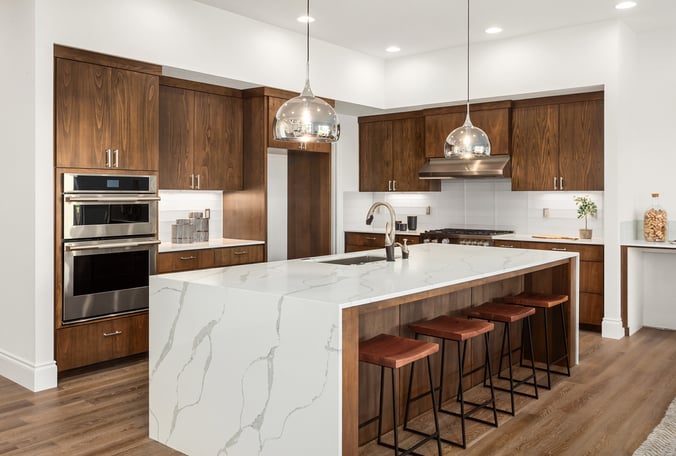
A waterfall countertop is more of an installation style than a traditional edge profile. Instead of ending at the horizontal surface, the countertop material continues vertically toward the floor along one or both sides of an island.
1. Consider the visual effect
A waterfall installation makes the countertop material a much larger part of the kitchen design. It works especially well when you want to highlight distinctive color, veining, or movement.
Waterfalls often suit:
- Large kitchen islands
- Contemporary designs
- Strong stone patterns
- Open floor plans
- Minimal cabinetry
Because you see so much more of the material, ld become even more important.
2. Look closely at the corner
Fabricators often use a mitered joint where the horizontal and vertical surfaces meet. Careful cutting and pattern alignment can make the material appear to flow over the edge.
If you want a waterfall, decide before finalizing the slab layout. Veins that stop or change abruptly at the corner can weaken the continuous look.
Which countertop edge is easiest to maintain?
Simple eased, beveled, and rounded edges usually require the least detailed cleaning because they contain fewer grooves and changes in direction. More decorative profiles can still work beautifully, but they need a little more attention.
If easy maintenance matters, compare:
- Number of curves or steps
- Places where crumbs could collect
- How easily you can wipe the edge
- How exposed the corners are
- How much detail the profile contains
Maintenance should not make the entire decision for you. The edge still needs to complement the countertop and the rest of your kitchen.
What should you decide before choosing a countertop edge?
Choose your countertop material and broader kitchen direction before making the final edge decision. The profile works best as a finishing detail after you understand the color, pattern, thickness, and surrounding design.
Before approving the edge, confirm:
- Countertop material
- Slab thickness
- Cabinet style
- Countertop color & pattern
- Island size
- Amount of exposed perimeter
- Preferred maintenance level
- Available profiles for your surface
Whenever possible, look at a physical edge sample rather than relying only on drawings. A small diagram cannot fully show how much visual weight a bullnose, ogee, bevel, or mitered edge will add once it runs around the finished countertop.
Where can I find an experienced countertop installer?
Kitchen Magic is a family-owned remodeling company that has transformed more than 60,000 kitchens since 1979. Our team can help you compare countertop materials, colors, thicknesses, and edge options in your own kitchen, then ensure professional installation once you make your choice. Call us today to schedule your free estimate!